
Staging a Revolution: Rehearsing Les Misérables.
As observed for The Lexington Theatre Company by Kevin Lane Dearinger
It’s the first day of rehearsal for the summer season.
First days can follow a recognizable pattern, but the pattern on this occasion has surprising variations.
Okay, so there are no tap shoes in rehearsal, but it’s more than that.
And yet, to be fair, The Lexington Theatre Company has proven its professional and artistic flexibility in over a decade of excellence. It has blazed with show-biz sparkle: 42nd Street, Legally Blonde, and the delightful Joseph and the Amazing Technicolor Dreamcoat. It raised goosebumps with Chicago and Jersey Boys. Charmed with A Christmas Story and A Christmas Carol, White Christmas, Mary Poppins, Newsies, and The Little Mermaid. Ran the ascending scale of emotions with The Sound of Music. Danced with poignant need in A Chorus Line. Bared the profound souls and human sorrows of West Side Story and Fiddler on the Roof. Challenged the conscience and the heart with a gut-wrenching production of Memphis.
And, okay, yes, the company has leaned toward shows that rely heavily on dance. There isn’t much about musical theatre dancing that the founders of the company don’t know. (And can do.)
So, Les Misérables?
A bit of dance if you don’t blink, and a lot of skillfully staged crowd scenes, but no dream ballet, no show-stopping ensemble kicking their legs high and in unison.
Not even nuns in devotional formation.
No choreographer on the creative team. (although a co-director who choreographs with every waking breath.)
Instead, music. Drama. Humanity. Big story. What a producer in London called “moral grandeur.” The human heart and its conscience.
And a cast of forty-seven.
Les Misérables is a very big musical and a very demanding work of art.
Day One wastes no time.
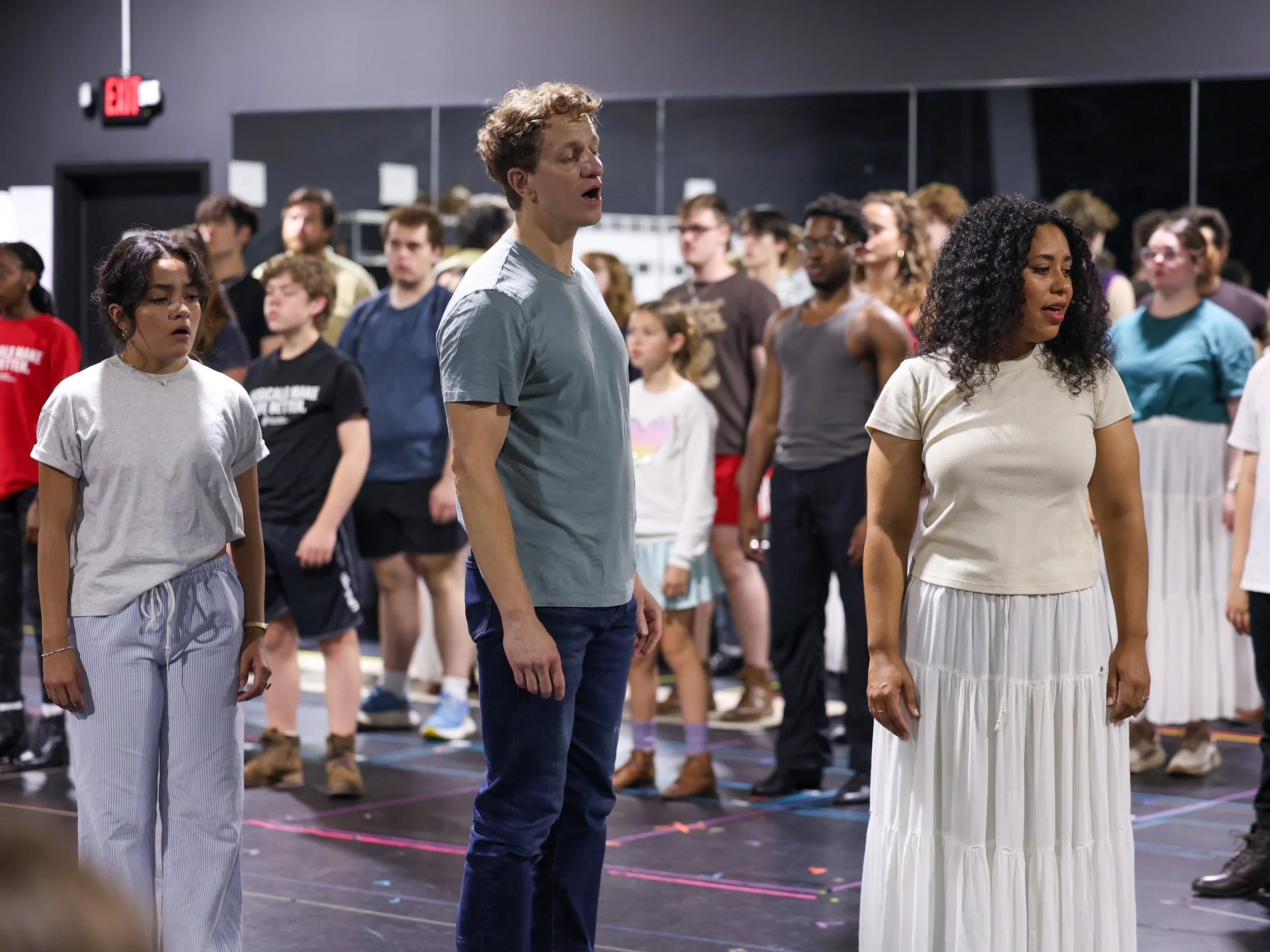
Leilani Miranda, Jeremy Landon Hays, Erin Elizabeth Clemons and Company in rehearsals. Photo by Chloe Bradley
Many performers are new faces, eager and fresh. They are glad to be here, in this town, with this company. The Lex conducts massive auditions around the country and online. Word is out in the performing world, and working at The Lex has national clout.
Eager and fresh, too, are the returning actors. An urchin face from last year’s A Christmas Carol. And Scrooge’s lost lover. Some schoolroom faces from A Christmas Story. The Fiddler from Fiddler on the Roof. Taller and wiser, an assortment of Von Trapp offspring from The Sound of Music. A few denizens from Forty-Second Street, sans feathers, sequins, and gowns cut on the bias.
They are excited. In an early music rehearsal, the announcement that an ensemble eighth-note in the score will be treated as a “quarter-note” causes a slightly-silly murmur of pleasure and a bit of hand-clapping. Then, a shared giggle at their such enthusiasm. First day, and all.
The first time the tenors are singled out, each singer looks around to see who is sharing those high notes with him. A nod of accord. It’s that kind of crowd.
As always with The Lex, the casting is impeccable. As each character emerges from the group, faces come into focus, voices define purpose, and one can only think, “Of course! Of course! So right for the role.”
Young Gavroche sings solo for the first time in front of his new colleagues. Applause. At the conclusion of the first full sing-through of “One Day More,” a soprano opens up with a note that will be heard in the Opera House in a few weeks and won’t go away for a few decades. Glory.
Musical Director Dr. Brock Terry, fortified with good cheer and an astonishing understanding of music, voice, and the art of teaching, is clearly where he belongs. “Y’all.” He introduces the vocal parts, working quickly but efficiently, focusing the sounds and clarifying the consonants as he goes. He is offering a master class. In every moment.
The air at the studios at The Lex is always a bit nippy. It’s the first day, and by lunch time, the actors have learned to grab a sweatshirt. And get back to work.
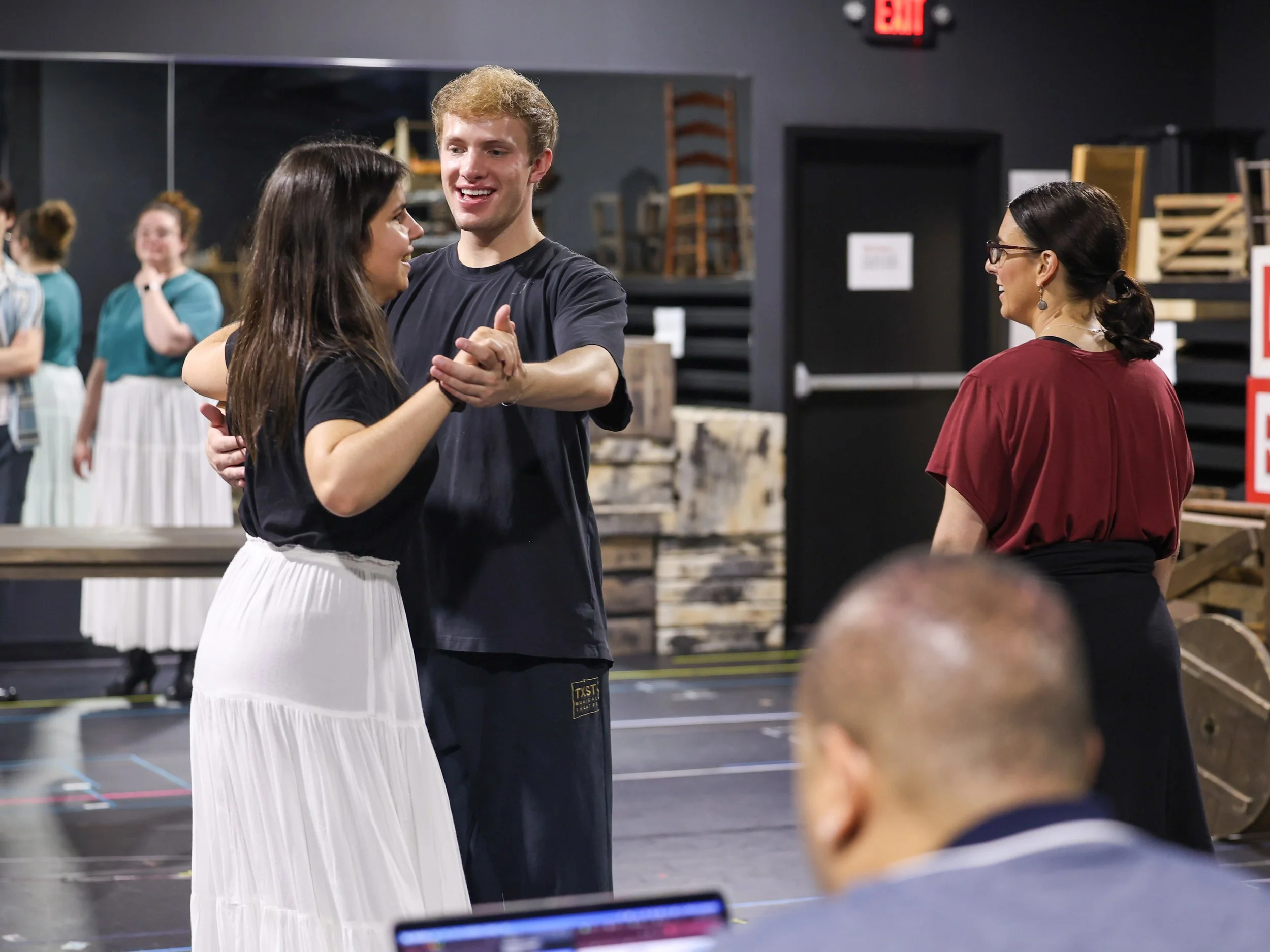
Haley O’Donnell, Caleb Sporrer, and Lyndy Franklin Smith in rehearsals. Photo by Chloe Bradley.
The second afternoon, the tone, but not the eagerness has shifted. The fully-adult members of the cast are rehearsing the, uh, low-life scenes. The younger performers are safely out of earshot. It isn’t a squeamish choice, but it is a tactful one. “Lovely ladies,” indeed. What comes through as pure and clean, however, is the strength of the melodies of Les Misérables and the haunting variations within those melodies. Ethereal triads and rhythms turned ragged with despair. Fantine’s misery accompanied by a nervous orchestral line. Terrified. The show is “sung-through,” without dialogue, ratcheting up the emotional demands. Nowhere to hide. The painful cries of physical need and the comfort-starved soul ring plaintively in every note and every rough-edged lyric.
Rehearsal turns to the rollicking “Master of the House,” the show’s beloved comic turn. It rollicks, sure, raucous and raunchy, but with the hard edge of individuals barely surviving in a harsh world. No escape.
The Lex is always protective of its artists. Nurturing. For Les Misérables, the company participates in sensitivity training. The show is intense. There are rehearsals devoted to improvisation. Even with a large cast, actors are encouraged to develop strong back stories for even the smallest role. It’s the sort of exercise that the Royal Shakespeare Company might conduct. (The RSC created Les Misérables, the musical.) Each actor is valued and encouraged. Trust is important. To its core, The Lex is about teaching and building confidence.
By the first weekend, the company is staging the musically and dramatically complex barricade scene. The technical demands are intense, but Jeremy Landon Hays, co-directing with Lyndy Franklin Smith, makes sure that each performer knows his or her contribution to the tapestry of hope, devotion, courage, and loss that will be this pivotal scene. When the principle performers join in, completing the action and the music, a new sense of wonder falls on the company. In the midst of a rebellion, an intimate scene, played downstage, shakes the room. The company can see and feel that they part of something honest and true and profound.
Get ready to cry.
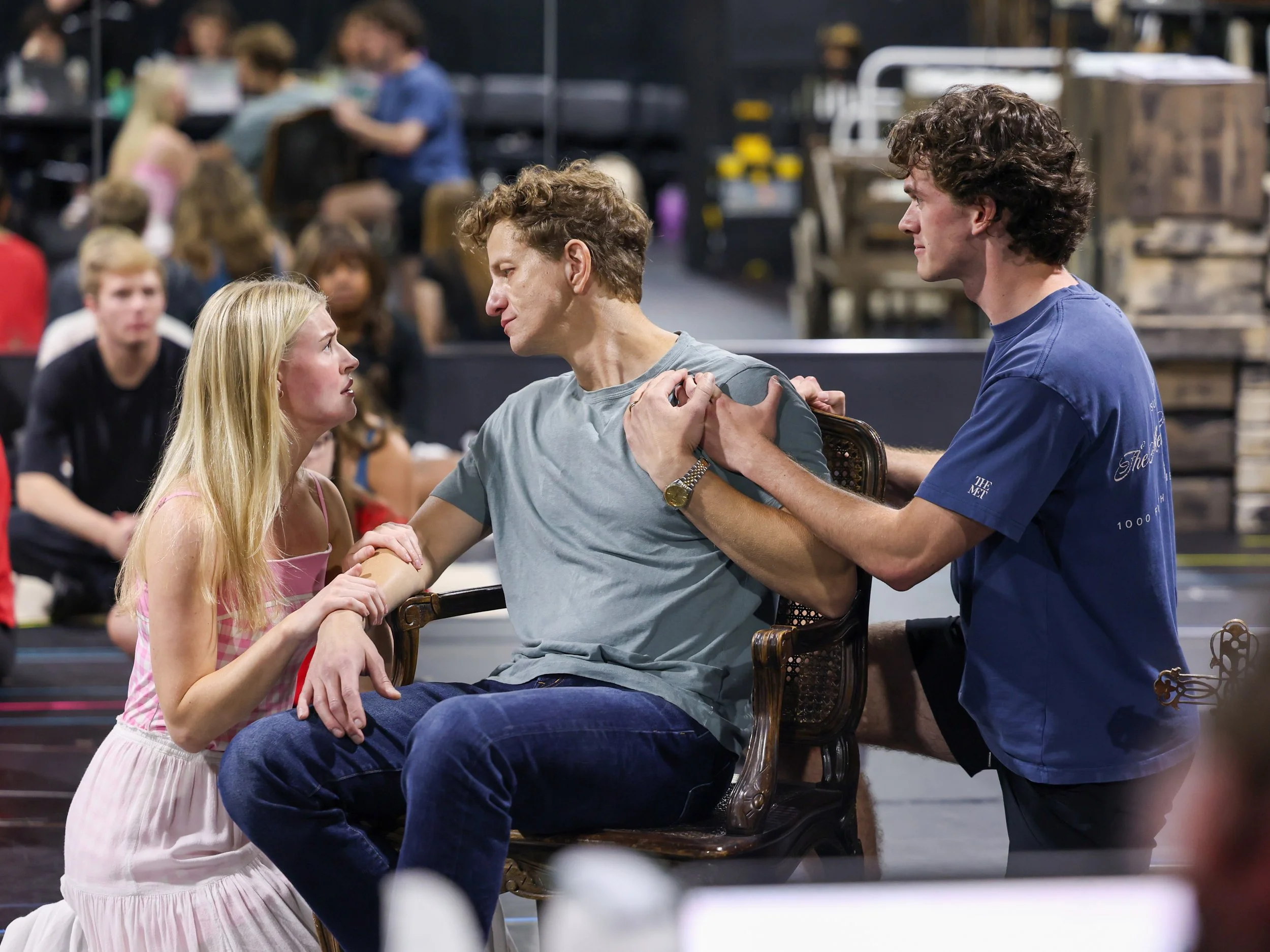
Charlotte Jensen, Jeremy Landon Hays, and Jayson Gorton in rehearsals. Photo by Chloe Bradley
As the second week begins, the company turns back to an earlier scene in the show and “At the End of the Day.” The stage is crowded, the staging is exact, and the commitment is total. The despair of the poor is razor-sharp with anger. Any flash of hope is smothered under spiritual exhaustion. Suddenly, Sweeney Todd looks like No, No, Nanette.
Get ready to thrill.
One more observation. Not the first, second, or third day, but by the fourth day, the company has reached a point that is always sublimely necessary in a rehearsal space. The actors, standing around, patiently running scenes and moves again and again, have begun to exchange supportive glances, begun to pat a new friend’s back, and, most importantly, when the time and place allows, they have begun to share small private jokes, ephemeral moments that are untranslatable to outsiders.
It is divinely human humor and comfort. It is the visible heart of the working artist.
Behind its crashing chords and clashing characters, Les Misérables is all heart.

The Lexington Theatre Company will present Les Misérables for four evenings and two matinees, July 9-12 at the Lexington Opera House.

Kevin Lane Dearinger is the author of several plays, five books of poetry, theatre biographies and histories, and two memoirs (Bad Sex in Kentucky and On Stage with Bette Davis). His most recent publication is At the Lexington Opera House, a Scrapbook, 1887-2026, available at bookbaby.com, amazon.com, and better book shops. He will also probably sell you a copy from the trunk of his car.
