
When the Soul Sings: Thoughts on Les Misérables
As observed for The Lexington Theatre Company by Kevin Lane Dearinger
Les Misérables.
Is big, non?
Famously so.
And French, non?
To its bones.
Eh?
Big and French.
Like the Palace at Versailles. (Ver-sigh, not -sales.)
C’est ènorme! C’est grande!
And if you know your Starbucks order: C’est venti?
(Yep, it’s big.)
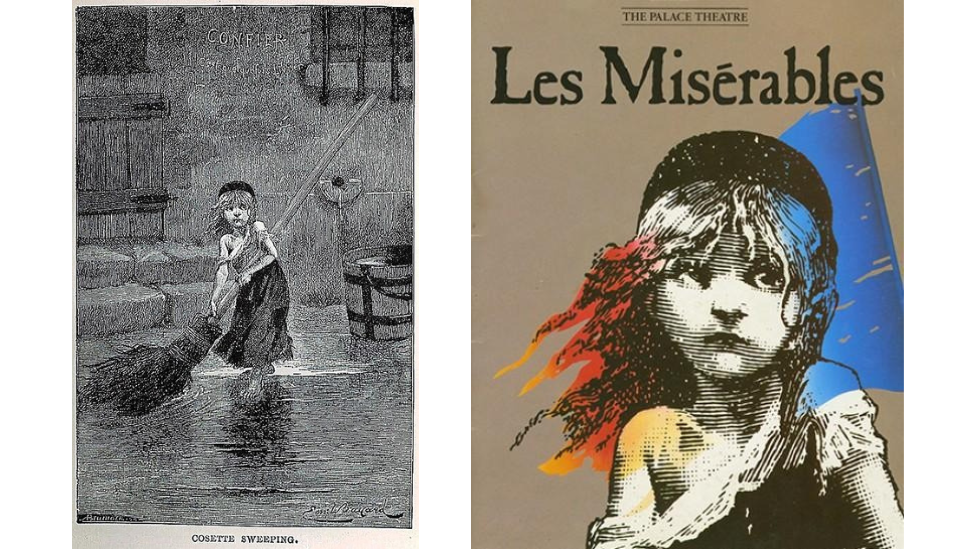
An early illustration, headed for fame.
Les Misérables is a big musical.
Victor Hugo’s novel was a big novel. Hefty. Longer than any Dickens’s tale and possibly longer than War and Peace on a double-bill with Crime and Punishment.
Also big, as in popular. Célèbre. Never out of print. Translated into languages around the world.
In 1844, Alexander Dumas published The Count of Monte Cristo, the story of a man unjustly imprisoned and struggling to choose forgiveness over revenge. The novel had much to say about morality and the individual conscience. In 1859, Charles Dickens produced his story about the famous French Revolution of 1789, A Tale of Two Cities—the guillotine and the best/worst of times. He wrote of political horror, unjust imprisonment, and the awakening of an individual conscience.
In 1862, Victor Hugo published Les Misérables. About that other revolution.
He was writing, of course, about the less-heralded June Rebellion of 1832. He had been an eye-witness to the violence in the streets. The bodies. The blood. His concerns were also political and moral. What awaits a society that ignores and suppresses its struggling classes? What happens when society tries to erase the individual? What happens when the laws of men fail to recognize the goodness in humanity?
Like Dumas and Dickens, Hugo recognized the individual conscience as something sacred.
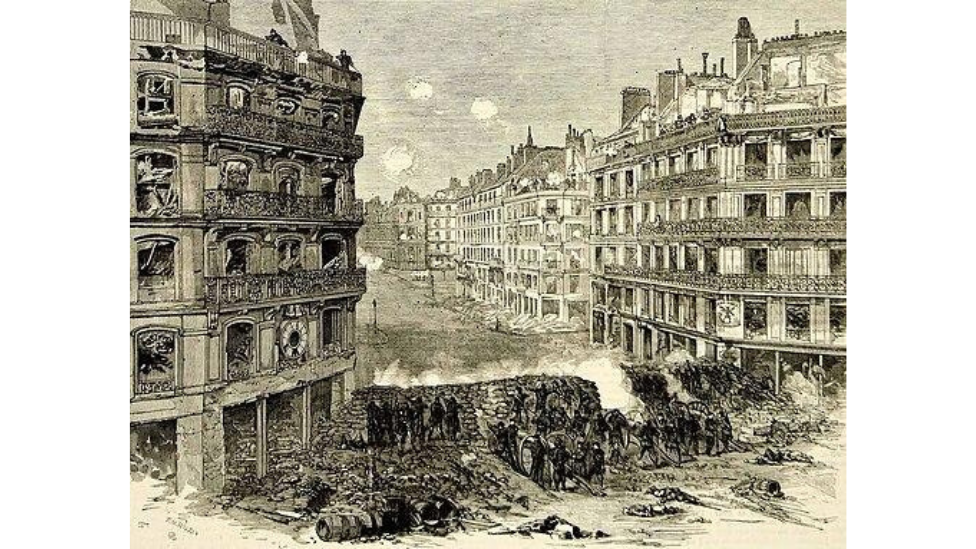
The barricades of Paris in the 1832 uprising. There were other rebellions in July of 1830 and February of 1848.
Hugo saw himself as heir to the Romantic tradition, finding comfort in capitalized Nature and innocence in human nature, trusting the innate decency of the human heart. It is no accident that in the novel Valjean’s better angels are first stirred in the countryside as he encounters a vulnerable child. He weeps previously unshed tears. His convict’s heart is softened when a sainted bishop respectfully addresses him as “monsieur,” an individual of worth and dignity.
Les Misérables waves its faith and humanism like bright red flags on a dark and moody stage.
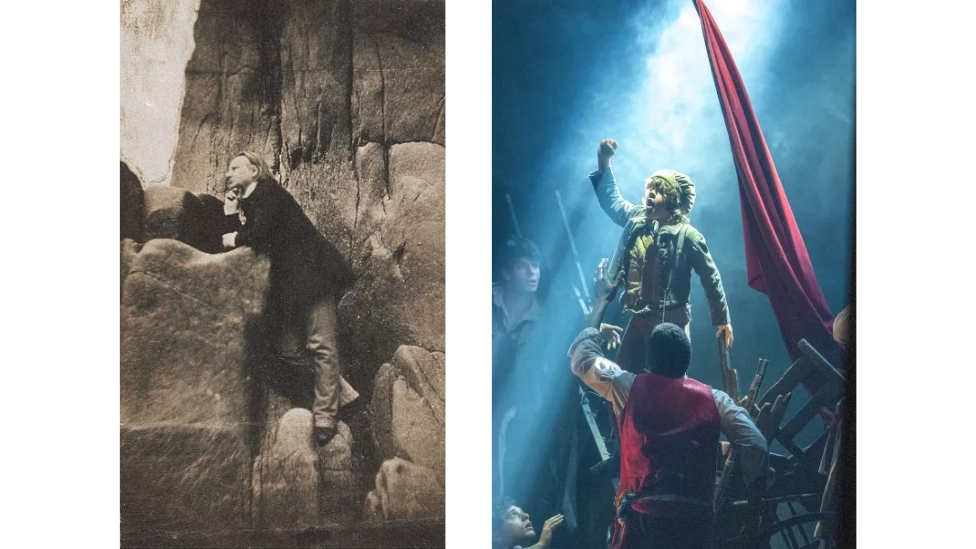
Young Victor Hugo as a Romantic, an individual in nature. And the child Gavroche at the barricade.
An English translation of Les Misérables appeared in America in 1862, during the Civil War, and became a favorite with the troops of both the North and the South. In a weary reference to the Confederate general, the soldiers called the novel, “Lee’s Miserables.”
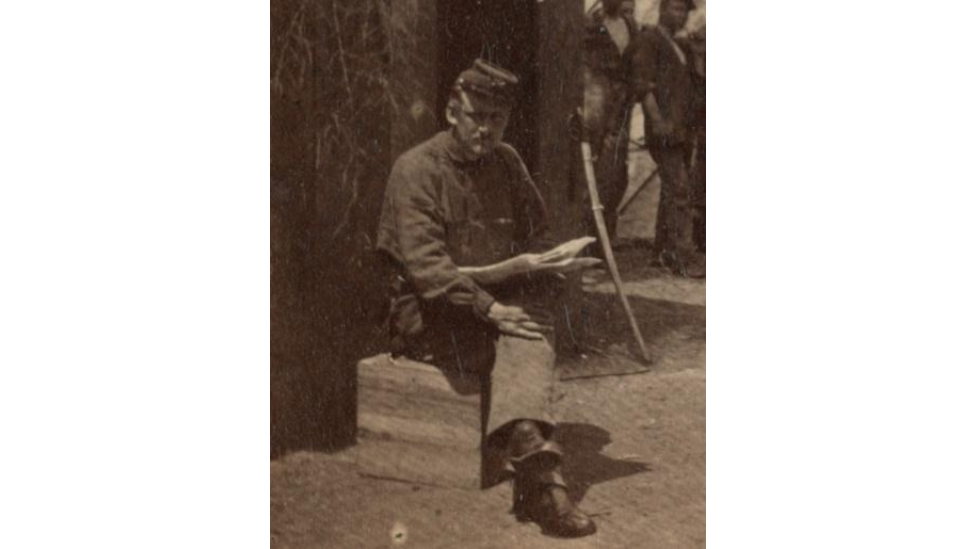
A Union soldier, reading.
Southerners, however, might have felt a rebuke in its final chapters. Hugo’s villainous Thénardier ends up in America where he becomes a trader of enslaved people. An ardent abolitionist, the author lets us know that Thénardier, unlike Jean Valjean (and Edmund Dantès and Sydney Carton before him), has sacrificed conscience to self-interest.
Although he was a highly successful playwright, Victor Hugo resisted calls to dramatize his many-limbed novel for the stage.
An American tried.
In 1864, Bronson Howard nibbled on one plot line and staged his play Fantine in Detroit—to limited success. He later rewrote that early effort as Lillian’s Last Love, and then as The Banker’s Daughter. Fantine and the entire French nation were evidently lost in translation.
Later, The Bishop’s Candlesticks (New York, 1909) would bite off another small portion of Les Miserables’ sprawling story as a one-act play for vaudeville. It later gained favor with school and community productions. Great drama, good roles, and not too long.
Hugo’s son Charles, working with playwright Paul Meurice, attempted to adapt the full arc of his father’s epic for an elaborate stage production in 1878 in Paris, with five massive acts, a massive cast, and massive stage sets.
Victor Hugo died six years later.
The first version of Les Misérables to play the stage at the Lexington Opera House was The Law and the Man in 1906, in three acts and five scenes. It starred Wilton Lackaye, an accomplished leading man and character actor best known for playing the sinister mesmerist Svengali. The actress playing Fantine doubled as Cossette. Les Misérables resisted taming for the stage.
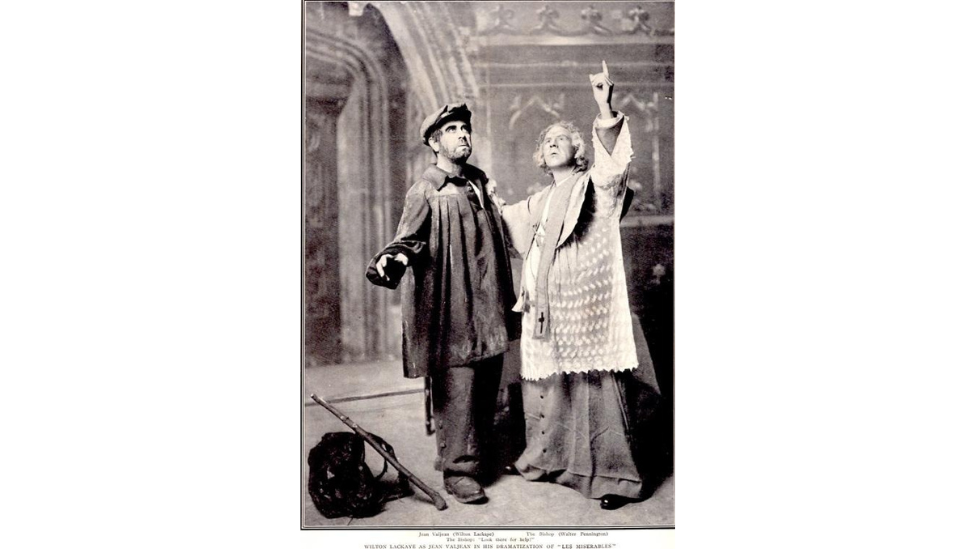
Wilton Lackaye as Jean Valjean and Walter Pennington as the Bishop, at the Lexington Opera House, September 18-19, 1906.
There were numerous silent film adaptations, many of them covering only a single strand of Hugo’s novel: a bit of Gavroche, Fantine’s tragedy, and sometimes an abridged chase featuring Jean Valjean and Javert. The Bishop’s Candlesticks resurfaced in silent film and in a very early sound film in 1929.
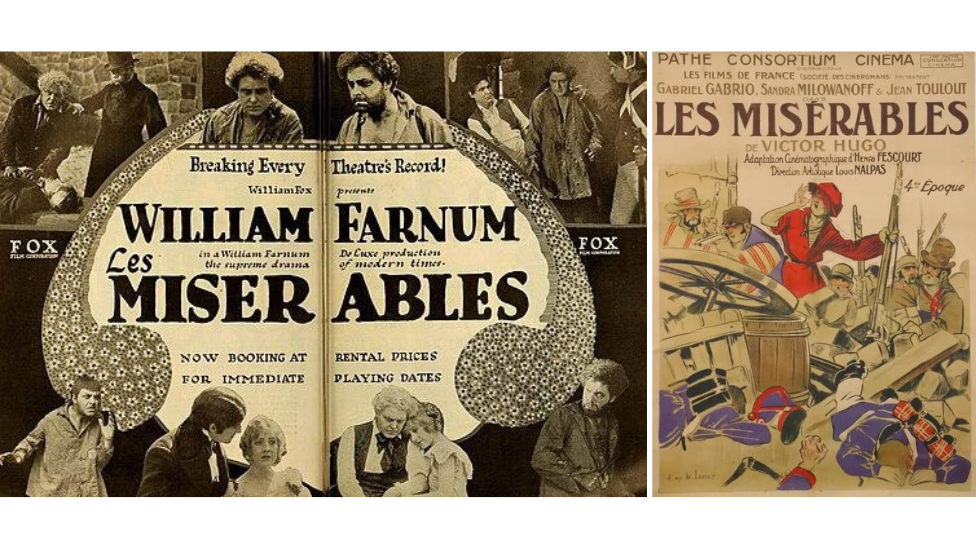
American and Continental silent film adaptations. (Public Domain)
Fredric March was Jean Valjean in the first major Hollywood “talking” picture of Les Miserables (1935), but it was Charles Laughton’s Javert, driven by pride and devoured by remorse and self-loathing, that stole the movie. Four years later, Laughton played Hugo’s heartbroken Quasimodo on the screen in The Hunchback of Notre Dame. (“Sanctuary! Sanctuary!)
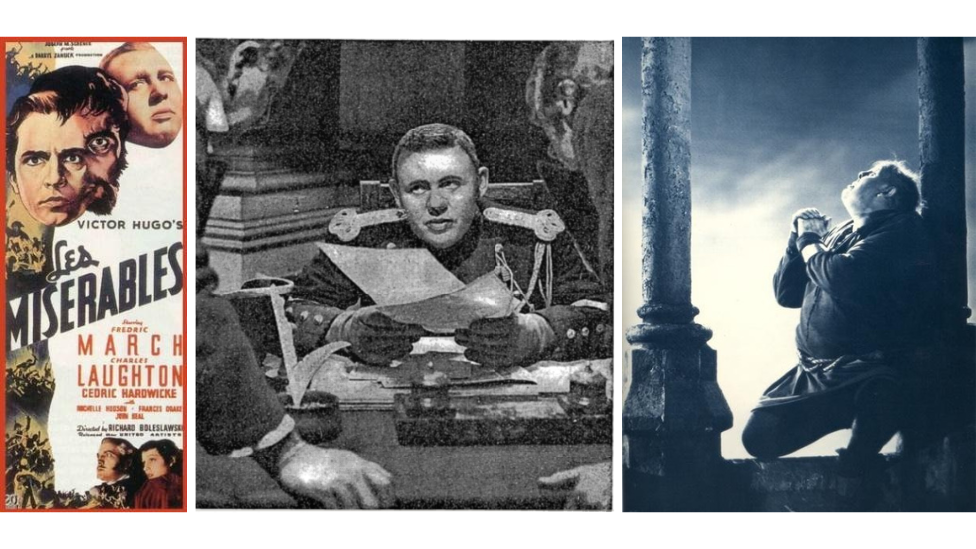
Hollywood at the barricade: Fredric March and the scene-stealing Charles Laughton as Javert; Laughton as Hugo’s Quasimodo.
Starring, writing, directing, narrating, and probably cooking a pot-roast for the cast and crew, Orson Welles brought the sprawling story to the radio in 1937, in seven, taut, half-hour broadcasts. As the vagabond Valjean, his sorrow-roughened voice told everything without elaborate exposition.
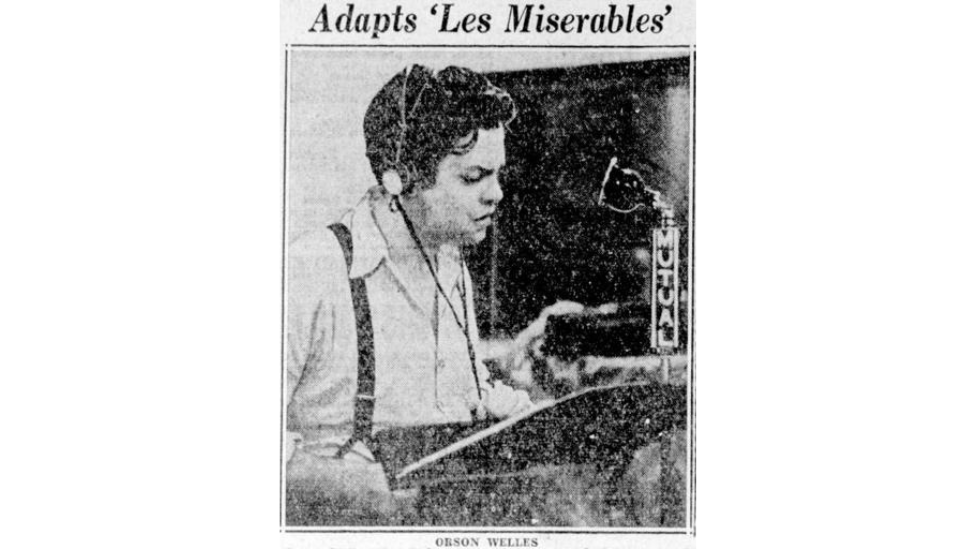
The Boy Genius in the studio. (Harrisburg Evening News, August 13, 1937, 20.)
Film and then television adaptations continued in two-hour, three-hour, seven-hour variations— one-night movies, stretched over a season, or streaming. Mini-series. Maxi-series. With a dazzling lineup of Jean Valjeans: Jean Gabin, Gerard Depardieu, Liam Neeson (of course,) Dominic West, and later, bless him, Hugh Jackman!
Over a hundred operas were based on Victor Hugo’s stories and plays, including Verdi’s Rigoletto, but a musical Les Miserables did not seem possible.
It had to wait for something new.
That something new was “the concept album,” an audio-recording, often a two-LP set (Remember LPs?), a series of songs that formed a dramatic story, of some sort.
Jesus Christ Superstar began as a concept album. So did Evita. Both English. Both from the busy fingers of Andrew Lloyd Webber. Later would come The Who’s Tommy and Chess. Green Day and Hadestown. And all those rock-operas, whatever that has come to mean.
When the French joined in with a concept album of Les Misérables, it was not a rock opera, not a traditional opera, and not a standard musical. It kept an emotional fever pitch by eliminating dialogue to create a sung-through drama with strong characters (from Victor Hugo), lofty thoughts (from Victor Hugo), and soaring tunes (from French pop and café traditions).
Someone called it a “popera.”
(Silly label!)
“On my Own” had a darker and less-subtle title in French: “L’Air De La Misere.” “I Dreamed a Dream” was “J’aivais Rêve d’Une Autre Vie.”
Rêve on, Fantine, but just wait until Patti Lupone gets her hands on you.
The album was extravagantly staged in a stadium near Paris. And closed after two weeks when the venue was booked with other attractions.
The future of the show was in doubt, but the energetic Cameron Mckintosh saw something promising in the “moral grandeur” of the story and the music by Claude-Michel Schönberg and Alain Boublil.
Mackintosh, a producer in London’s West-End (for profit), joined forces with the Royal Shakespeare Company (non-profit) to revise the musical for the English stage. Mackintosh thereby saved money on initial production costs and salaries, set up some tax breaks, and retained a hefty portion of the show’s eventual profits.
And he got Trevor Nunn as the director.
“Clever Trevor” had earned that title with Shakespearean productions, including a legendarily stark staging of the Scottish play, and he had directed Cats. Yes, Cats. But he had also proven his theatrical brilliance with an elaborate staging of Nicholas Nickleby, a much-lauded eight-and-a-half hour adaptation of a meandering Dickens’ novel, with actors playing multiple roles on a revolving set.
Hmmm. Sound familiar?
Eventually, Nunn and his collaborator John Caird would manage to tell Hugo’s much longer story in just a bit over three hours, with a quick-changing ensemble and revolving stage. Later cuts would bring the show in just under three hours to avoid overtime with the stagehand, musician, and wardrobe unions in the United States.
In London, the show developed around the talents of the exceptional RSC actors, including young and dynamic Patti Lupone, imported as a guest from America in the wake of her break-out triumph as Evita. The show had “leading roles,” but it was an ensemble effort. The stage musical has never given billing to an individual actor or identified a performer “above the title.”
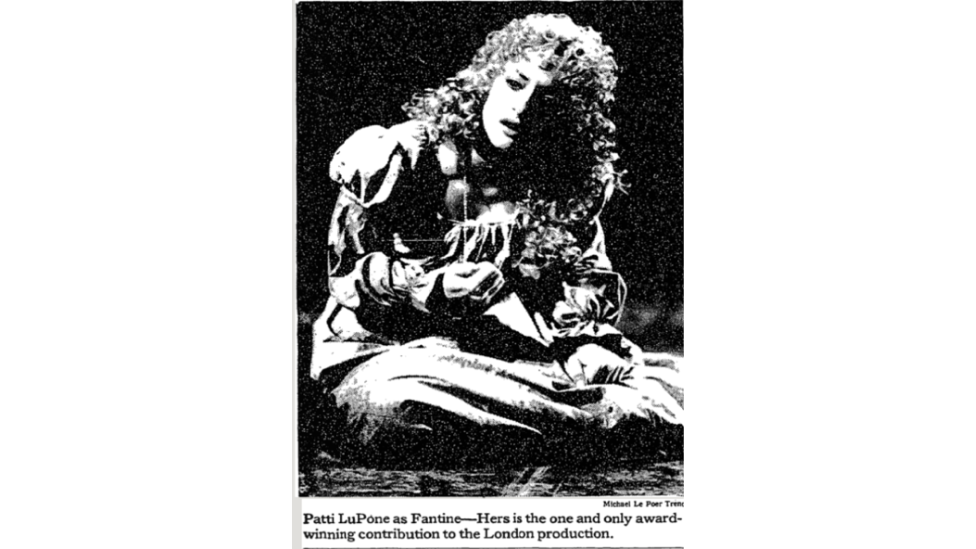
Patti Lupone as Fantine in London. (NYT)
The show was reimagined and performed with English lyrics.
One song, however, was new, not a part of the French concept album.
It provided a theatrical close-up of human decency in the midst of unspeakable violence. Its emotional honesty remains devastating.
Schönberg and Boubil finished writing the sublime “Bring Him Home” two weeks before the London production opened. It was tailored to the extraordinary voice of the first English-language Valjean, Colm Wilkinson.
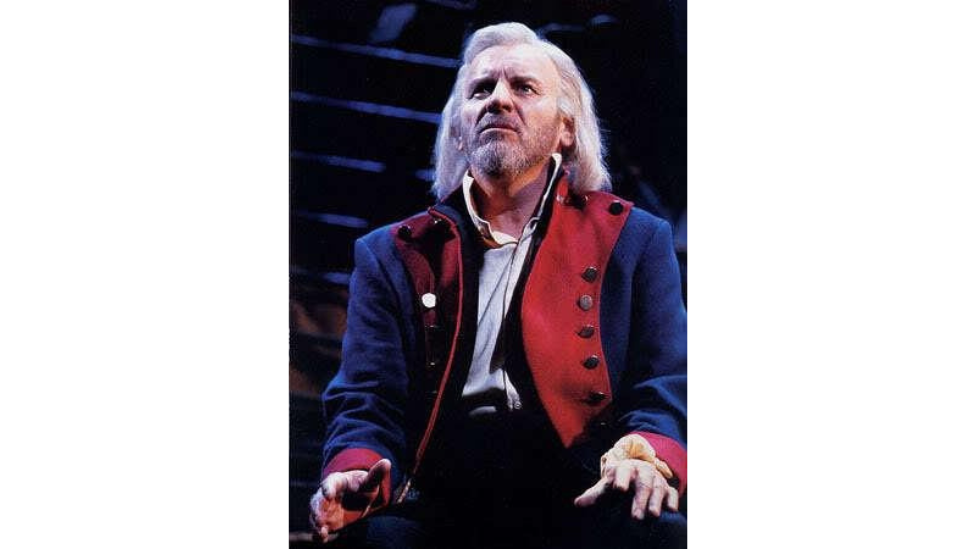
Colm Wilkerson moves prayer into song.
Anecdote: When Wilkinson first sang “Bring Him Home” for the London company, director Trevor Nunn comforted his weeping actors, “I told you that this show was all about God.” “Yes,” replied one of the actors, “But you didn’t tell us that you had engaged God to sing it.”
And although it has been parodied as “Too High. This Song’s Too High,” “Bring Him Home” has moved audiences to shivers and tears ever since, with a long-line of Valjeans baring their heaven-reaching souls.
(The Lex is blessed with a singing actor in touch with the ethereal regions.)
In 1985, the London critics loved Mr. Wilkinson, Ms. Lupone, and their stage companions, but not so much the show. London rarely embraced French musicals, and in return, Paris usually snubbed British and American musicals. When Cameron Mackintosh later took his successfully reimagined Les Miz to Paris, he nearly lost his last monogrammed shirt.
The initial reviews accused the show of being “witless and synthetic,” the “reduction of a literary mountain to a dramatic molehill,” and the emasculation of Victor Hugo.
“A singing telegram.”
Cynics called it “The Glums.”
A few critics, however, praised the production for its “blazing theatricality” and for breaking “brand new ground...between Verdi and Andrew Lloyd Webber.”
(A histrionic Scylla and Charybidas, if ever there was one.)
Broadway pounced.
The “British Invasion of Broadway” was well underway. Cats was still in fresh litter. Phantom of the Opera and Miss Saigon were on the theatrical horizon. Nicholas Nickleby had provided dramatic thrills and a lifetime of bragging rights. (I was there! I was there!)
New Yorkers made the show a hot ticket long before it opened.
Several London cast members, including Wilkinson but not P.L., arrived in New York with Les Misérables. Broadway energy sharpened the story-telling and the performance edge of a French and British creation.
Something new, yes, but also something old.
Les Misérables proudly nods to Broadway history.
“One Day More” closes the first act much as “The Quartet” provides the thrills to the end of the first act of West Side Story.
Thank you, Jerome Robbins.
The turntable and cinematic scene changes owe much to Fiddler on the Roof.
Thank you, Jerome Robbins.
Gypsy allowed musicals to explore the darker shadows of human behavior.
Thanks, Mr. Robbins!
Those shows allowed musicals to offer drab costumes, smudgy faces, moody lighting, and stark stories. Think The Lost Boys, not Schmigadoon. (Bless them both!)
London’s West End was accustomed to warbling light sopranos; Broadway and American vaudeville gave musicals the show-stopping high-belt voice. Amplification allowed the singers to be heard above the increasingly electronic orchestra, powering ever-higher belts, quieter crooning, and the lightly-floating falsetto.
The production recouped its investment in twenty-three weeks.
In the aftermath of Les Misérables, sung-through musicals became part of Broadway’s menu. For a few years, every show seemed to have a turntable, massive scenery, and a busy ensemble. Chandeliers. Helicopters. Turbans. Norma Desmond coming down that enormous staircase. (“I am big!”)
The original New York production of Les Misérables ran for sixteen years.
It devoured singing actors. A slow chew and hard swallow.
Every performance seemed to announce a long line of understudies “in the role of...” In 1996, Cameron Macintosh fired most of the New York company in his “Sunday Night Massacre” and recast the show, citing a need to refresh the production.
Touring companies proliferated, staged duplicates of the Broadway company that could only fit into the larger touring venues. Conductors encouraged actors to perform as much like the New York company as possible. Microphones moved from the footlights to the chest to the hairline, before seizing the side of a head like a crab-leg. Bigger meant louder.
But then, musical theatre has always reinvented its realities.
Personal note. A few years after the explosion of Les Misérables on the theatrical scene, I played a supporting role in the First National Company of The Secret Garden. An American musical, mind you, with, yes, an English setting. We had a turntable and cinematic story-telling. We had moody lighting and a gloomy ensemble of unhappy ghosts. We had a beautiful score that drew less from traditional Broadway and more from folk, pop, and the edge of opera. A former and future Jean Valjean, our leading man had a haunting falsetto..
Although The Secret Garden was set in the early years of the twentieth century, the hair design for the men, we were told, was “just like Les Miz.” Long and “romantic,” more reminiscent of the Parisian barricades than the Raj or the manor house. Many of the actors and the crew had recently finished long runs of Les Misérables in New York or on the road. Did I imagine that they all tended to walk with one step forward, two steps back on the turntable? (IYKYK) And almost all the brilliant young actresses playing Mary Lennox had previously played Young Cossette or Young Eponine. One was the sister of the original Broadway Gavroche. At ten, eleven, or twelve, they understood how to carry a musical on their tiny shoulders.
Les Misérables built up performance stamina.
Another thought about the evolution of Broadway musicals.
In 1972, a second row, center, orchestra ticket for Sondheim’s spectacular Follies was twelve dollars. When Les Misérables opened in New York in 1987, the top price for a seat was $47.50. Something had to pay for that four-ton barricade, a large cast, and massive crew. By 2001, a “premium” ticket to The Producers was ringing up at $480. Today? Well, if you have to ask...
Broadway loves spectacle, and spectacle has had its effect on Broadway.
The Lexington Theatre Company’s Les Misérables won’t have a turntable, but their production will offer sensitive staging, strong ensemble acting, heartfelt drama, vivid characters, an electrifying orchestra, and soaring vocals.
Greatness is greatness!
And, yes, Les Misérables is big.
But so is its wild heart!
Coeur sauvage!
Note: No French-speaking persons were actively injured in the creation of this document.
Bonus Trivia:
Name three of the four Broadway shows with scenes set in a sewers!
At thirty-five years, which big British musical holds the record for the longest Broadway run?
Name another musical that began with the Royal Shakespeare Company and will be seen later this summer at The Lex?
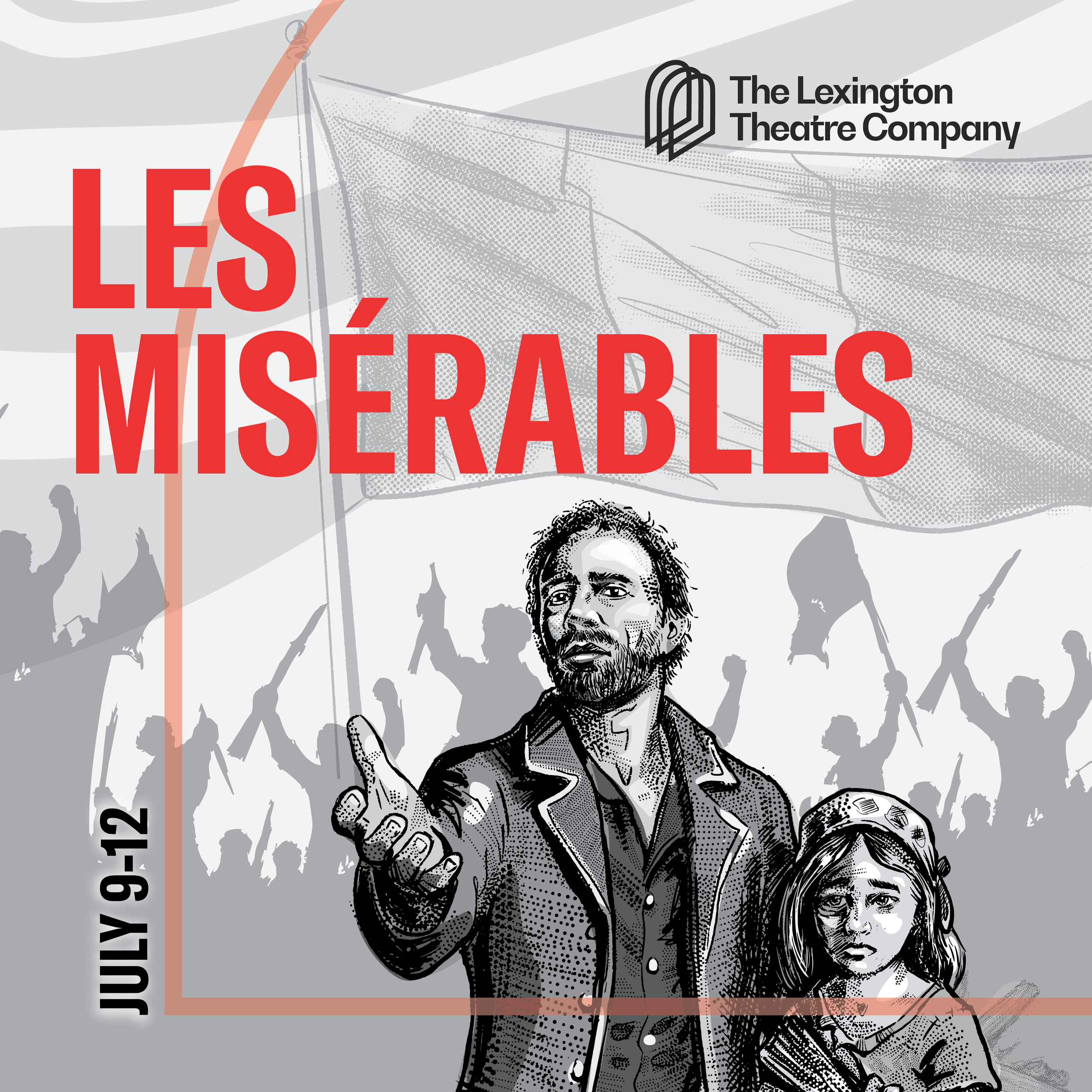
The Lexington Theatre Company will present Les Misérables for four evenings and two matinees, July 9-12 at the Lexington Opera House.

Kevin Lane Dearinger is the author of several plays, five books of poetry, theatre biographies and histories, and two memoirs (Bad Sex in Kentucky and On Stage with Bette Davis). His most recent publication is At the Lexington Opera House, a Scrapbook, 1887-2026, available at bookbaby.com, amazon.com, and better book shops. He will also probably sell you a copy from the trunk of his car.
