
Matilda Evolving: the Making of a “Naughty” Musical.
As observed for The Lexington Theatre Company by Kevin Lane Dearinger
“Sometimes you have to be a little bit naughty,” sings young Matilda, in the musical that bears her mighty name.
A bit naughty?
Sounds like murky doings in La Cage or Cabaret or maybe Moulin Rouge.
But not that kind of “naughty.”
Kid “naughty.”
The sort of activity often called playful, mischievous, impish, rascally, before moving into ill-behaved, unacceptable, shameful, disgraceful (spoken while peering down a long adult nose), reprehensible, and (from a tomato-red adult face) criminal.
Or entirely understandable behavior, given the circumstances.
It’s not easy being a kid. You are small. You are often dismissed as if somehow slow-witted. You have no power. You are given rules that seem silly. And they change all the time, without notice.
It’s enough to make a kid naughty.
Author Roald Dahl understood “naughty.” It gave him an odd bond with the imagination of children. Kids, he remarked, like to be scared a bit. They like suspense. They love magic and chocolate and giggles. They enjoy a villain who meets a gruesome comeuppance. They like fast-moving narratives and have little interest is descriptive passages.
The author was tall, and it would be nice to think of him as his own BFG, Big Friendly Giant.
It would be nice.
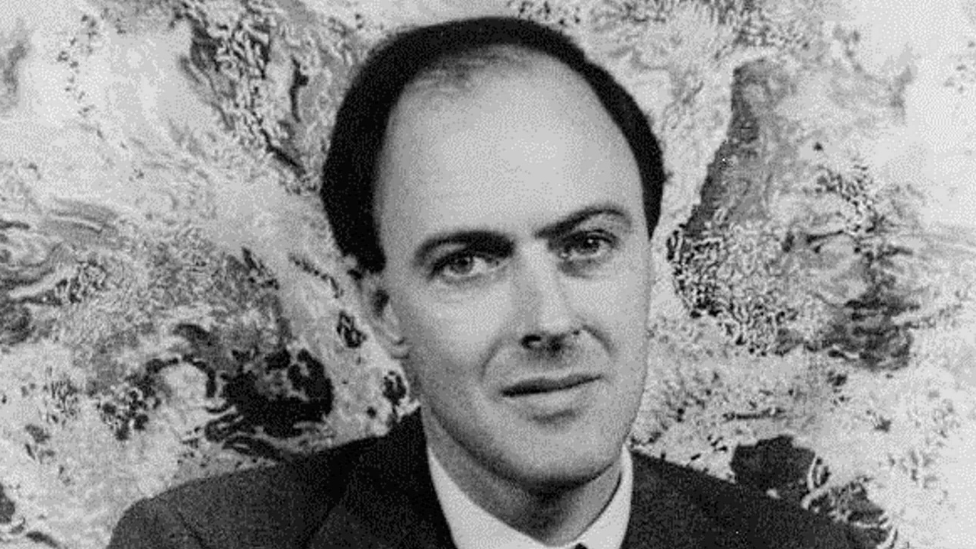
Roald Dahl
Examining Roald Dahl’s life, however, takes a strong stomach. He often rewrote his personal history. “I don’t lie,” he said, “I merely make the truth a little more interesting.” Or more self-serving. He suffered great losses, tragic bereavements, and harrowing war injuries. Still, he often revised the facts to make a better story.
Roald Dahl (1916-1990) was born Wales. His Norwegian mother called him “Apple,” as in the “apple” of her maternal eye. His fellow-soldiers during World War II noted his great height and air of grandeur and called him “Lofty.” His first wife, Kentucky-born actress Patricia Neal, Oscar-winner for her extraordinary performance in Hud, called him “Rotten Roald.” She would know. He helped her recover from a debilitating stroke by a relentless form of “tough love” and then left her for a family friend. The television movie about her recovery scrubbed-up the story for prime-time.
Dahl had substantial intelligence, a genius for storytelling, an unmistakable charisma, an unrestrained ego, and boundless energy. He called it being “sparky.”
He was also a bully, a sexist, and a bigot. Rotten, indeed. He was “appallingly intolerant and cruel.”
His dark side was insidious, but it informed his literary creations. When critics accused his work of being “brutish” and “ugly,” he responded, “I never get complaints from children. All you get are giggles of mirth and squirms of delight.”
He had a long career as a celebrated author of not only children’s books, but of supernatural tales, crime stories, and even somewhat queasy erotic fantasies (for Playboy).
An early story about gremlins caught the attention of Walt Disney, who summoned Dahl to Hollywood with a possible movie deal. It didn’t happen.
He contributed a number of scripts to American television in its early days of live telecasts and experimental dramas. He wrote for Rod Serling’s TheTwilight Zone and adapted one of his macabre stories for Alfred Hitchcock’s anthology series. “Lambs to the Slaughter” followed a sweet Fifties’ housewife. She kills her husband by smashing his head with a leg of lamb. She cooks the lamb and serves it to the detectives investigating the murder, eliminating the murder weapon. It was an instant classic.
Dahl’s dark comic vision was a constant.
Although he was a very successful screenwriter, he did not have much luck with stage plays. The Honeys, his 1955 Broadway debut, started as a story of a sweet, unfortunate lady who murders her husbands. Plural. It somehow became about two sweet sisters who murder their husbands, twins, each a candidate for the meanest man in the world. Dahl intended satire. The critics were bored and unamused, and Dahl fought with this producer and director, souring the experience. He rewrote the play for an English audience but only prolonged the agony of failure.
Matilda would have better luck on stage.
Dahl scripted the film You Only Live Twice for the James Bond franchise and gave the world the diabolical Ernst Stavro Blofeld, the villain with the white cat and the direct inspiration for Dr. Evil in the Austin Powers series. Very silly stuff. One can hope that Dahl would have been amused by the tribute.
He also provided the first script for the film of Ian Fleming’s Chitty Chitty Bang Bang. Yes, Chitty was based on a book by the creator of James Bond. Dahl fought with the director and the producer, but his ghoulish imagination created the truly terrifying Child Catcher.
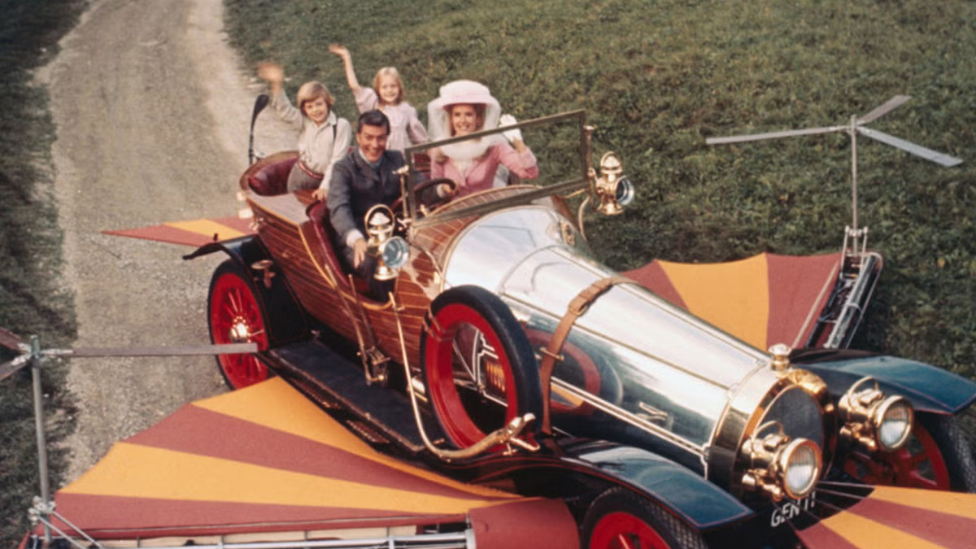
Chitty Chitty Bang Bang (1968)
Dahl’s work often included characters with a sinister view of children. He adapted his own Charlie and the Chocolate Factory for the big screen as Willie Wonka and the Chocolate Factory, a nod to Gene Wilder and a character who is equal parts magic and danger. Note: the badly behaved children in the story do not really die, although they are chastened and changed. Poor Veruca, however, is stuck with that name.
Which brings us back to endangered children.
Matilda was author Roald Dahl’s final full-length novel. In addition to Charlie and the Chocolate Factory, he had already given the world BFG, The Witches, James and the Giant Peach, and Fantastic Mr. Fox.
In its earliest form, the telekinetic Matilda was a hardened racetrack habitué, scheming to win money to rescue her favorite teacher, an odd combination of D. H. Lawrence’s “The Rocking Horse Winner” and Stephen King’s Carrie. This Matilda came to a bad end.
Perhaps it helped that Dahl’s favorite book as a child (Also Matilda’s) was Frances Hodgson Burnett’s The Secret Garden, with it rebellious, truth-telling heroine, holding her own against a hostile adult world.
Considerably rewritten, Matilda was an immediate success when it appeared in 1988. It sold 100,000 copies in hardback in its first year and 500,000 copies in paperback in its first six months.
The first film adaptation came six years after Roald Dahl’s passing in 1990. The New York Times praised the show’s “lessons” (Reading is good. Evil is punished.), but worried about Trunchbull’s physical violence. With some relief, the Times noted that even when tossed out of windows, the schoolchildren did not seem to sustain permanent injuries.
The Royal Shakespeare Company, which had been in the stage musical business since the runaway success of Les Misérables, thought that the story and characters of Matilda might make a great stage show.
Musicals often soar or falter on the strength of their “book,” that is, the script. Writer Dennis Kelly realized that Dahl’s episodic narrative was not quite ready-made for the stage. “Dahl just wasn’t a playwright,” he said, bluntly enough. (Dahl had been dead for a while, like Jacob Marley.) His adaptation of the novel, however, seemed all-Dahl. Not “sanitized” for the musical stage. In fact, he borrowed storylines from Dahl’s short stories, gave Matilda’s eager mind a series of fantasies, making her not just a reader, but a storyteller, and eliminated Hortensia, a major character, to keep the focus on the title role.
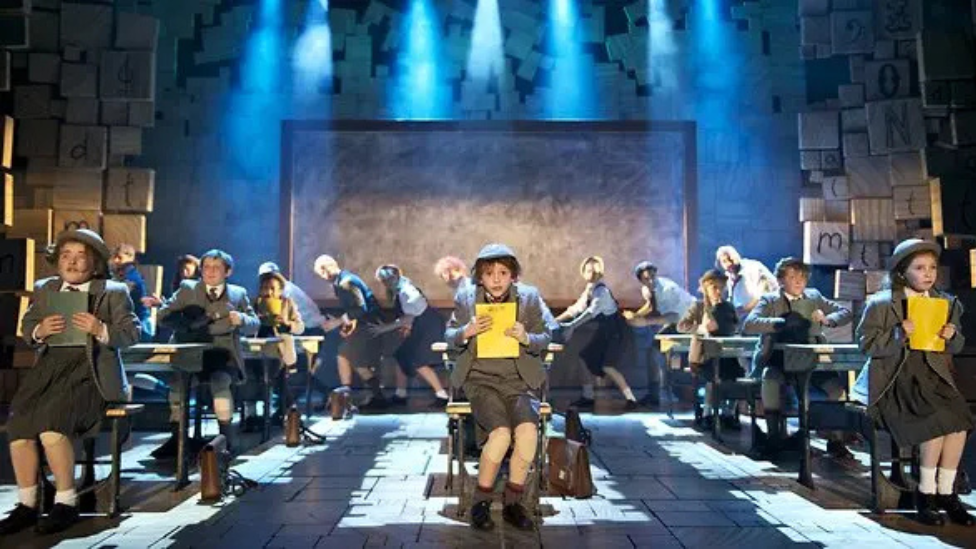
The Royal Shakespeare Company’s Production of Matilda (2010)
He didn’t soften the story, and, in fact, Kelly’s Matilda became a more active agent of “naughtiness” than in the novel. The voracious reader of books (Great Expectations, The Sound and the Fury) was primed to let her imagination run wild, unleashing a bloodless mayhem. The critics celebrated the “wonderfully twisted” plot. Even the “pin-sharp” choreography seemed to carry a “creepy darkness.” Any schoolteacher can tell you that the most well-regulated, calm classroom is just a dance riot ready to happen.
The show needed to be “dark and funny,” and, frankly, just “not Disney.”
The Trunchbull was to be played by a female actor, as the creators did not want the character to seem like a panto dame. But the male actor they cast created his part so carefully that the audience thought only for moment, “That’s a man!” and then accepted the towering nightmare as the sadistic headmistress.
Initially, Matilda was to be the only character in the musical who didn’t sing. She was “shy,” reasoned the creative staff, and “the world sings around her.” Then they realized that was silly. She was the protagonist of the story, after all. We wanted to hear her thoughts in song.
Poor Matilda! For a short time, she was to be played by a puppet, and the creative staff experimented with having adult actors play the schoolchildren. They worried about writing a show that fell on the shoulders of a little girl. But Annie had taken that chance. And The Secret Garden depended on a strong young actress. But Matilda? In the end, Like Billy Elliott, four young performers shared the role, each slightly different in approach, but all strong little pros.
Never underestimate the strength and determination of a child actor. Never.
Perhaps the winning piece of the puzzle was Tim Minchin, a comic and musician, who had no faith is his ability to write a musical and then did so with invention and wit. He wrote with warmth but without sentimentality. He didn’t believe in telling an audience what to feel.
As “naughty” Matilda sings:
Even if you're little, you can do a lot, you
Mustn't let a little thing like, 'little' stop you
If you sit around and let them get on top, you
Might as well be saying
You think that it's ok
And that's not right!
And if it's not right!
You have to put it right!
Matilda, the Musical, brought new glory to the RSC and a fresh source of revenue. It is still running in London’s West End. The Broadway production won a raft of deserved Tonys, but although the favorite, the show failed to win Best Musical. The Broadway crowd moaned at that injustice like a kid treated unfairly by the adult world.
New Yorker delighted, however, to find a show that enthralled younger audiences, touched the hearts of the older theatre-goers, and had a quick wit for all ages. It appealed to all those who had been bullied, felt injustice as a child, discovered themselves in the glory of reading, or felt misunderstood in a messy world.
That’s a great many of us.

The Lexington Theatre Company will present Matilda, the Musical for four evenings and two matinees, July 30-August 2 at the Lexington Opera House.

Kevin Lane Dearinger is the author of several plays, five books of poetry, theatre biographies and histories, and two memoirs (Bad Sex in Kentucky and On Stage with Bette Davis). His most recent publication is At the Lexington Opera House, a Scrapbook, 1887-2026, available at bookbaby.com, amazon.com, and better book shops. He will also probably sell you a copy from the trunk of his car.
