
Matilda Is Here! And All’s Right with the World!
As observed for The Lexington Theatre Company by Kevin Lane Dearinger
Matilda!
She doesn’t coax the blues right out of the horn.
She doesn’t wear a red-feathered headdress down the steps at the Harmonia Gardens.
She doesn’t bake anyone into a meat pie.
She doesn’t flash a green fishtail.
She isn’t a sharpshooter in a Wild West Show.
She doesn’t transform from flower-girl to duchess.
She doesn’t perish on a Parisian barricade.
She doesn’t join the “merry murderesses,” and she is never exactly “in the room where it happens.”
But she is young, bright, and a prodigious reader of books.
So she can imagine all of these scenarios. Matilda can be anything, anywhere, whatever the adult world thinks of her.
And she can rule a musical.
When she knits her brow in concentration, the world can shake and move. When she makes a tiny fist and flexes her intellectual muscle, adults should tremble and maybe hide.
Matilda’s intelligence makes her a target for the selfish and the unkind, but it is her salvation, too.
The mighty Maddox Ellis finds all of Matilda’s stubborn goodness, unstoppable curiosity, determination for justice, and strategically-detonated “naughtiness.” Her tender voice, her sturdy stance, her inquisitive eyes, and tender heart are a winning-combination.
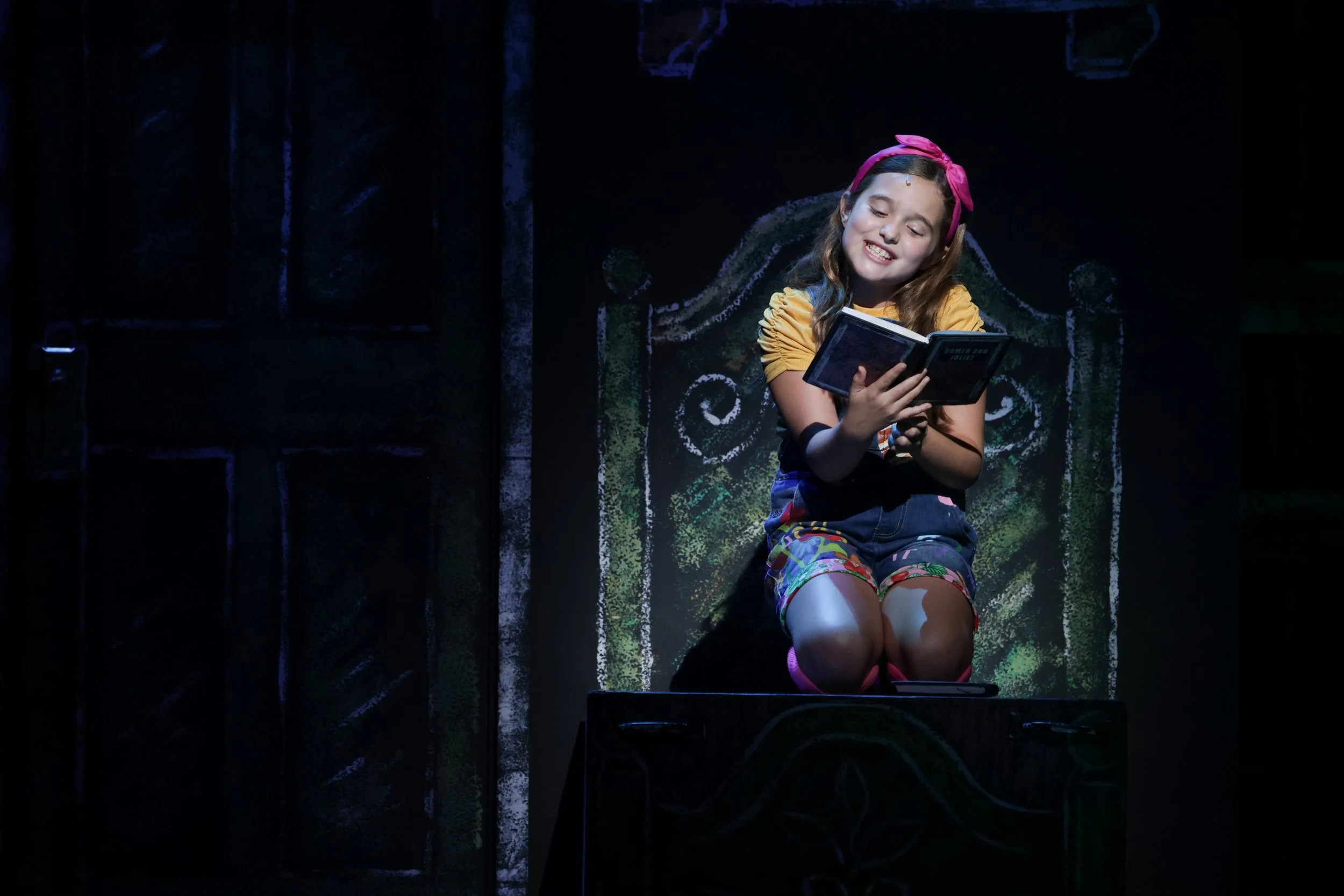
Maddox Ellis
Certainly, any and every audience will fall in love with this Matilda.
Parents and teachers, of course, should be loving, protective, and encouraging. Thank heaven, most are. But not in Matilda’s tiny world.
With endangered children, unreasonable adults, and delayed justice, Matilda, the Musical, has elements of a fairy tale and of a horror story. It also spins out elements of magic, for there are dragons of sorts, if not to slay, then to banish. Five-year-old Matilda finds her magic within herself. It’s a powerful discovery.
Matilda the Musical, keeps thematically true to Roald Dahl’s novel but expands and focuses the plot and the characters. Matilda becomes not just a reader, but a storyteller, weaving a world that makes better sense of sorrow than reality might dictate. Stories have power.
Tim Minchin’s lyrics are, in turn, silly and touching, and just, well, wacked. The opening number seems to mock the modern insistence that every child must be a “princess,” “a miracle,” or a “special little guy,” even as the specialness of the individual will emerge as a theme for the musical. Fresh from the maternity ward, Matilda’s negligent mother wails, “I should be dancing the tarantella qui mon fella Italiano.” Sondheim might chuckle.
Minchin’s music is also slightly mad and more than genius. Writing for very specific characters and situations, his musical markings might offer traditional directions, such as “legato” or “allegro,” but he is also likely to suggest that the songs be “quirky” or “frantic” or “tempestuous” or “nervous” or “Russian” or “Psycho-esque.”
Matilda’s world can be scary.
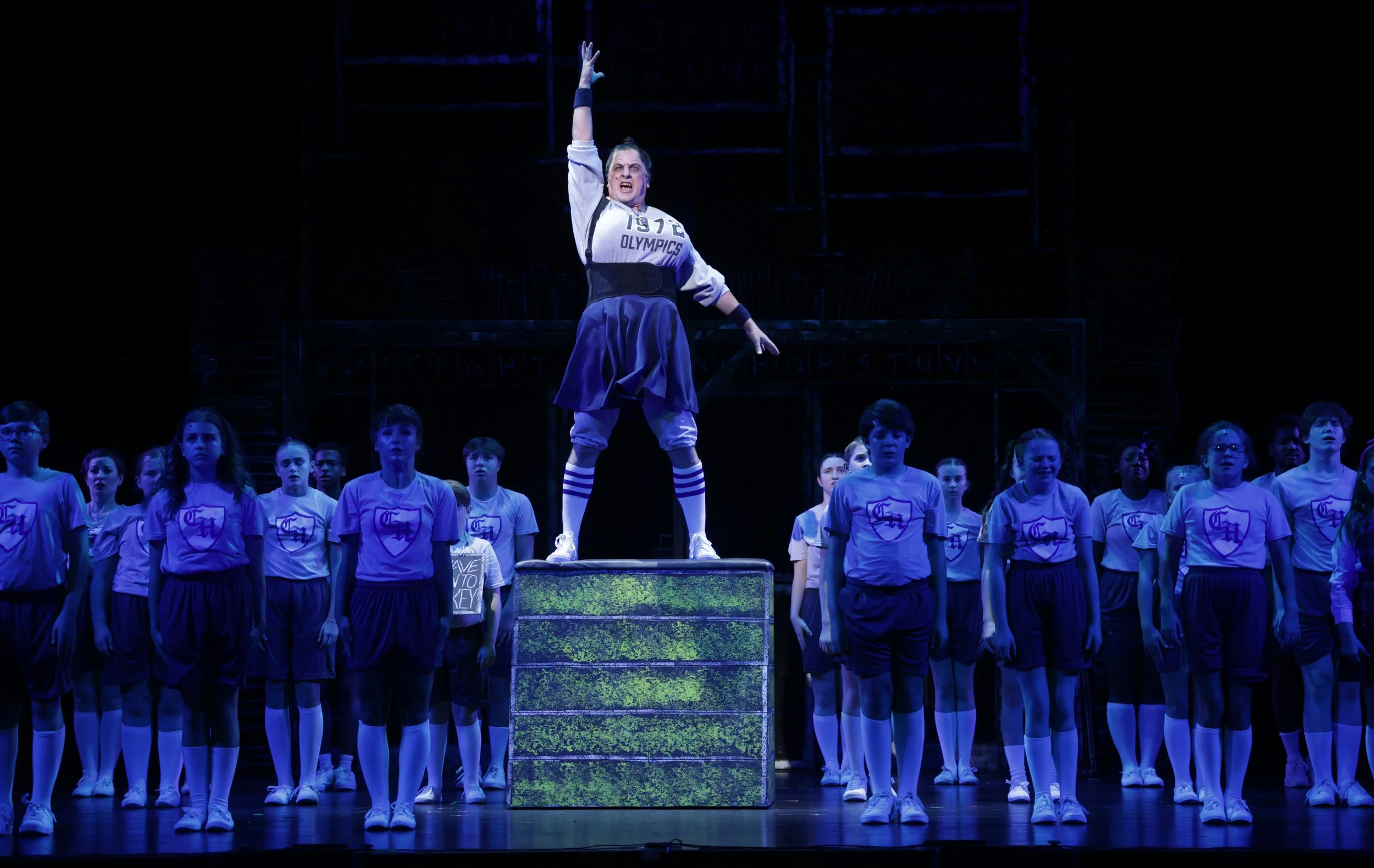
Justin Packard and the Company of Matilda
The Trunchbull, the monstrous headmistress at Matilda’s school and as warm and cuddly as her name, scowls at the intimidated “maggots” in her charge, ever suspicious that there might be “a whiff of insurgence” or “the odor of coup” in the classroom ranks. A former hammer-throw champion, The Trunchbull has no qualms about tossing a small child out a window. Justin Packard finds an infinite variety of meanness and the infinite vanity of an Olympic-class bully who never quite realizes that all it will take is the laughter of children to undo her. Children always know when a preening adult is really just ridiculous. Meanwhile, Justin glowers, storms, bullies, and then flashes a turned out leg and graceful ballet arms. Well, even hell-on-stout-ankles has its moments, I suppose.
And look out, Justin has great vocal “money” notes! Solid!
As Matilda’s selfish mother, Mrs. Wormwood, Kristen Beth Williams is in perpetual motion, arms akimbo and fingers flashing a mean manicure. In her pencil-skirt with just enough ruffle to shout “tacky,” she looks every inch an illustration from Dahl’s novel by Quentin Blake. When she cuts loose (or looser) with the salsa-slinging, show-stopping “Loud” and partners with the pelvis-twitching, (“Very supple!”) Rudolpho of uproarious Jayson Gorton, the atmosphere gets steamy.
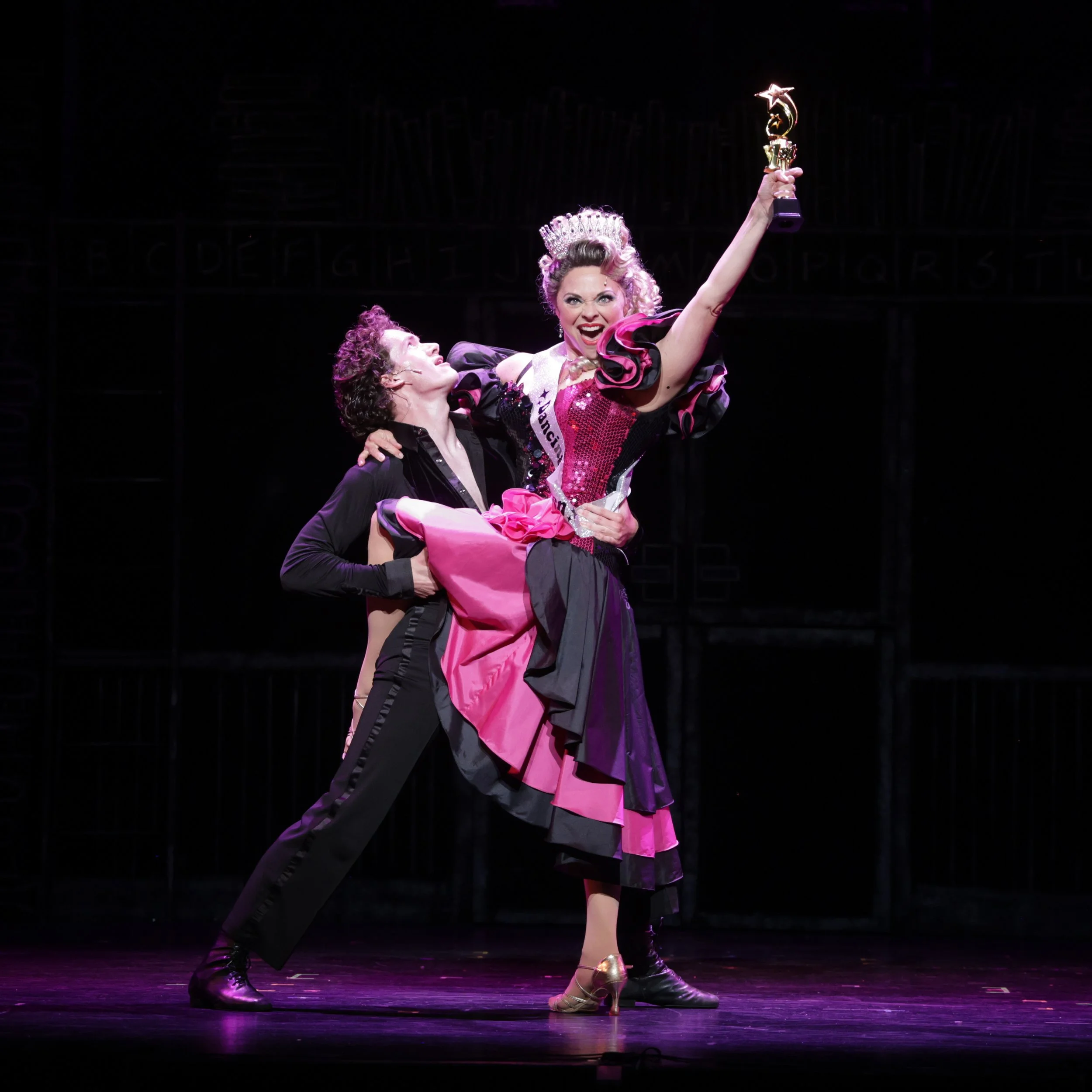
Jayson Gorton and Kristen Beth Williams
Even as the comedy spins out into an ever-more joyous silliness and knickers get in a celebratory twist:
A little less brain, a lot more hair.
A little less head, a lot more derrière.
Another accomplished comic and master of music-hall schtick, Matthew Michael Janisse struts with all of Mr. Wormwood’s misplaced confidence, spilling over with ignorant prejudice and free-flowing malapropisms. Matilda’s father hates books. There’s a good chance that books would hate him—just on principle. Principles? The world’s most-crooked used-car salesman, Mr. Wormwood has none, except self-interest and an allegiance to vulgarity. In his second-act crowd-pleaser, assisted by the reliably goofy and deliciously slack-jawed Ian McKinney Nunnelley, Mr. Wormwood sings the praises of mind-numbing television viewing, wonderfully unaware of how foolish he is. It is great satire and just flat-out funny.
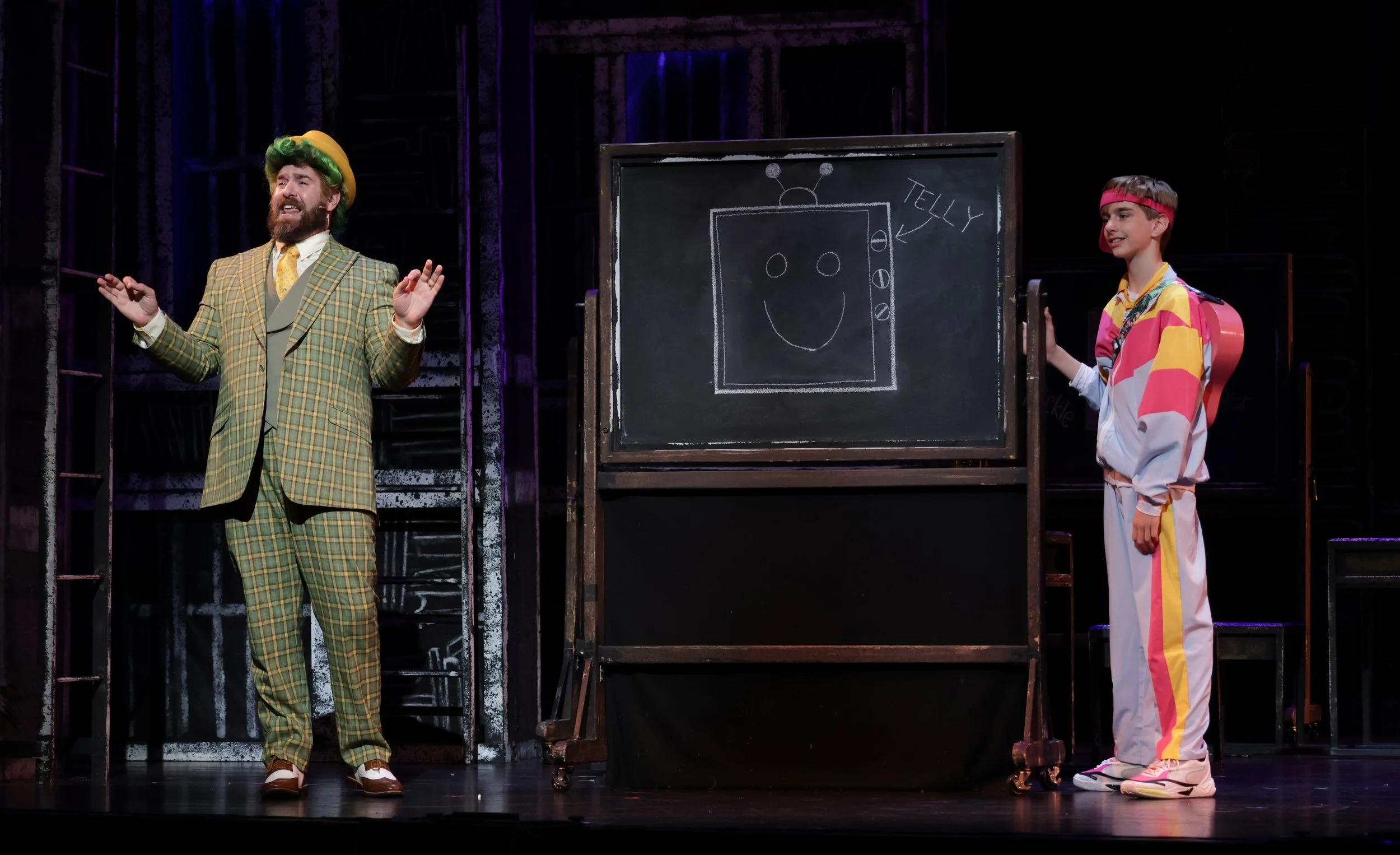
Matthew Michael Janisse and Ian McKinney Nunnelley
Children have so few defenses against adult cruelty, but a bullied child can be, if not saved, at least made less vulnerable, by a sense of the ridiculous. Matilda’s quick intelligence gives her a clear view of the pettiness of her parents and headmistress. Her mind also protects her heart, allowing her to give and seek kindness, to nourish and preserve her much-abused gift for empathy. When she shares her clear-headed vision of decency with her classmates, the battle is on.
There are the “Big Kids” on the first day of school—terrifying prophets of doom—and what they do with the alphabet is enough to send public education and civilization into permanent regression. They have learned only bullying from their headmistress, but they are ripe for revolution. These “Big Kids” include some of the most beloved faces (and talents) at The Lex.
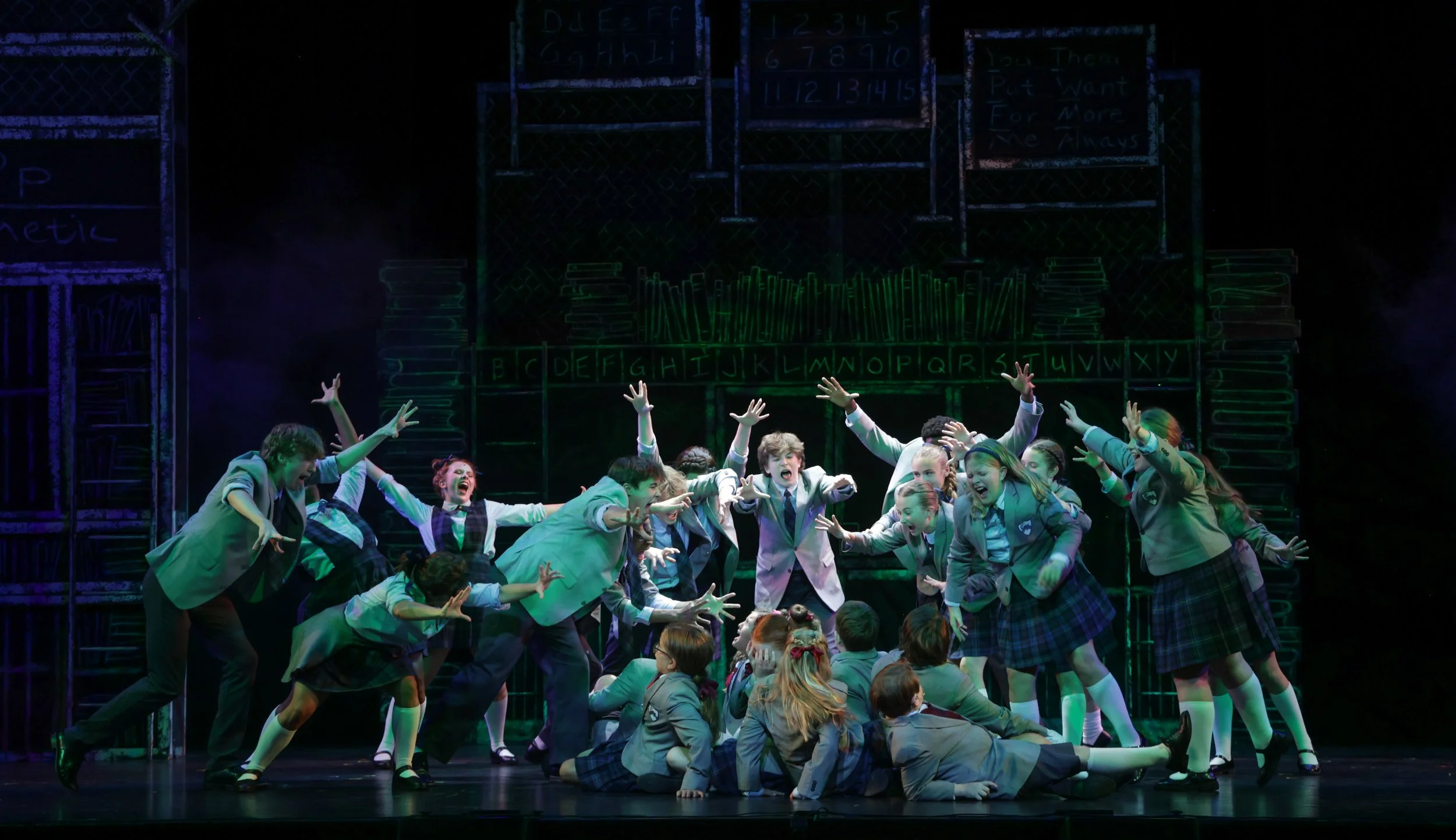
The Company of Matilda
The “Little Kids” are another wonderful mix of familiar and new faces. They work individually and in stand-out featured moments with skill and professional polish. The Lex’s education program has so much to be proud of. Watch the characters Nigel, gaseous Bruce, Eric, Alice, Lavender, fatally pig-tailed Amanda, and their friends. You will be glad of their acquaintance. (All played by clever and highly disciplined little pros!)
Matilda can paint its story in bright primary colors, but underneath there is always a recognition of the reality of childhood traumas, the need for love, and also that necessity of acknowledging the specialness of each individual child. Matilda’s fantasies, the stories she tells, reflect her heartbreaking need to be loved.
Luckily, little Matilda Wormwood finds a few loving adults.
Mrs. Phelps, the librarian, is played by the always extraordinary Catherine Gaffney, who seems even to blow her nose with a Scottish burr. Mrs. Phelps is entirely enchanted by her tiny visitor, sharing books and wonder, and listening like a spellbound captive of Sheherazade to Matilda’s tale of the Escapologist and the Acrobat (Ari’el Chaim Barmor and Ellen Pierce, both heartbreaking). It is a story that will carry great resonance before the final curtain. Matilda’s magic can astonish.
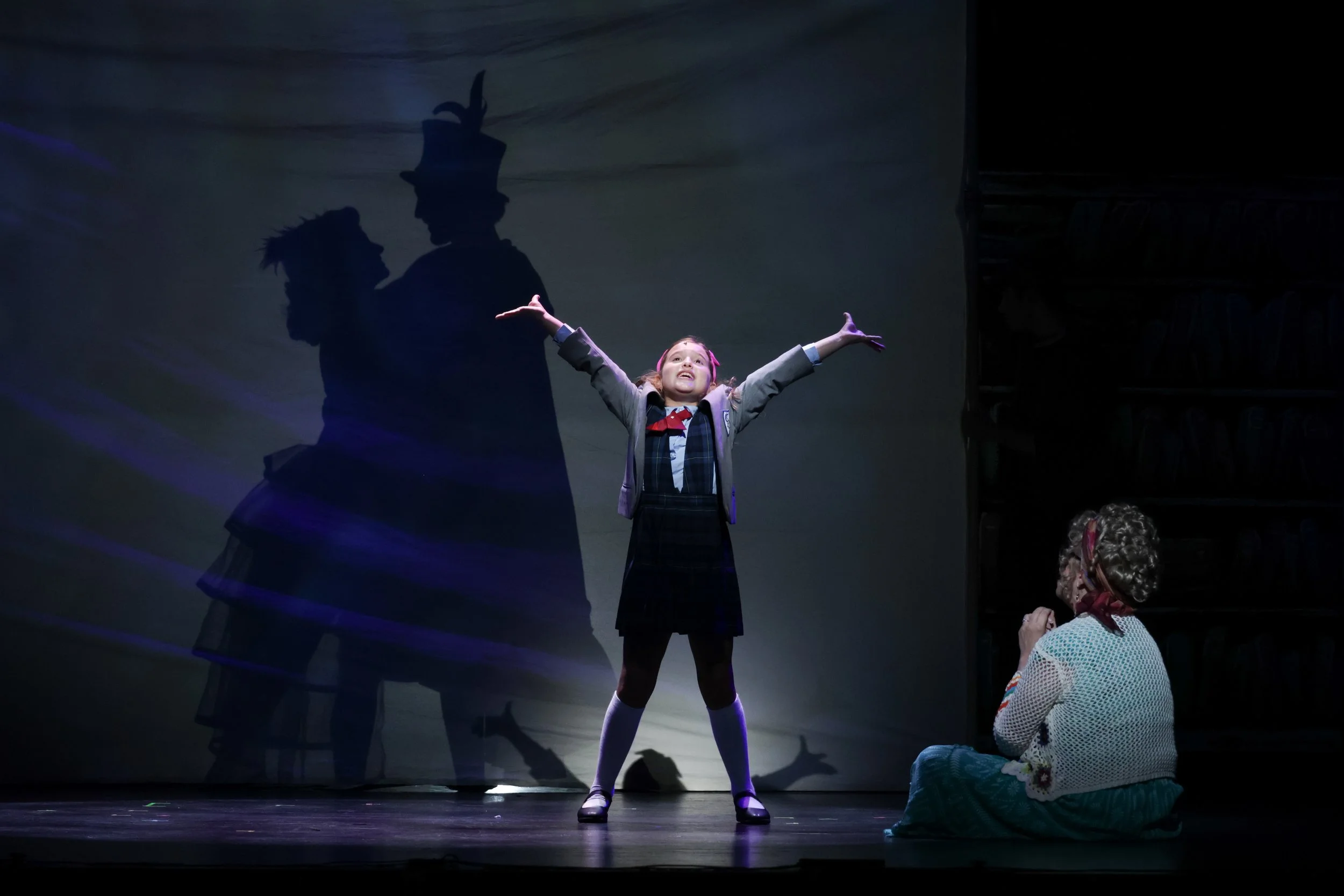
Ellen Pierce, Ari’el Chaim Barmor, Maddox Ellis, and Catherine Gaffney
Miss Honey, beautifully acted, sung, and felt by Astoncia Bhagat, has everything a great teacher needs—kindness, again, is key—but she feels powerless against The Trunchbull. Not that fear stops her from defending Matilda. “What sort of teacher would I be,” she sings, “if I let this little girl fall.” Together, however...
Well, that is the miracle of Matilda.
This musical offers a rich evening in the theatre, thrilling for children who instinctively find it “true,” and touching to adults, who sometimes have to be reminded of the truth.
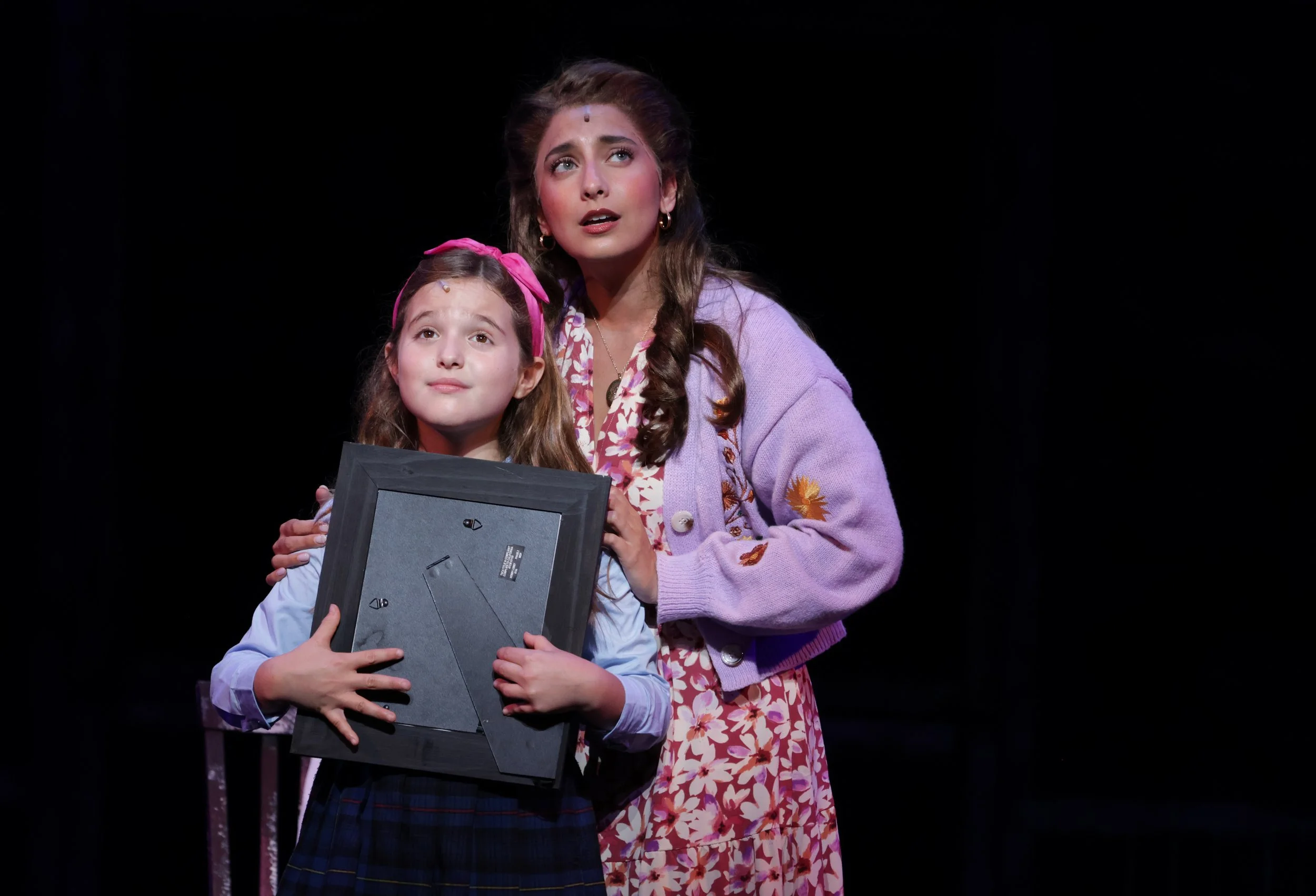
Maddox Ellis and Astoncia Bhagat
All of this comes out in the careful direction by Drew Humphrey and the meticulous and good-humored choreography of Elizabeth McGuire. Elizabeth has been with The Lex from its first show. This is her stellar debut as a choreographer. Among other wonders, the alphabetical “school song” earns a winter-term’s worth of A+ marks. Oh, welcome home, Elizabeth!
The musical direction of Dr. Brock Terry embraces and celebrates the joyous and diverse score. For Matilda, he has eleven top-notch musicians, playing a total of twenty-three instruments. Brock sees that musical scores are always well-sung at The Lex, but in Matilda, when the children escape their daily fears to sing “When I Grow Up,” the harmonies seems to spring from the purest musical wells. More magic.
And Luke Krohmer has a “Lion King Moment.” Trust me.
The production has a distinct look. Robin L. McGee has provided a wardrobe of grey blazers, short pants, and wool skirts to brand the regimented English schoolchildren, pastels and floral prints to suit Miss Honey, garish displays of terminal bad taste for the Wormwoods, and a suitable emotional straitjacket for that human Land Rover that is The Trunchbull. The skill of her astonishing wardrobe crew is always visible if you know how much work they have done. (It’s in the precision of planning and detail of craft.)
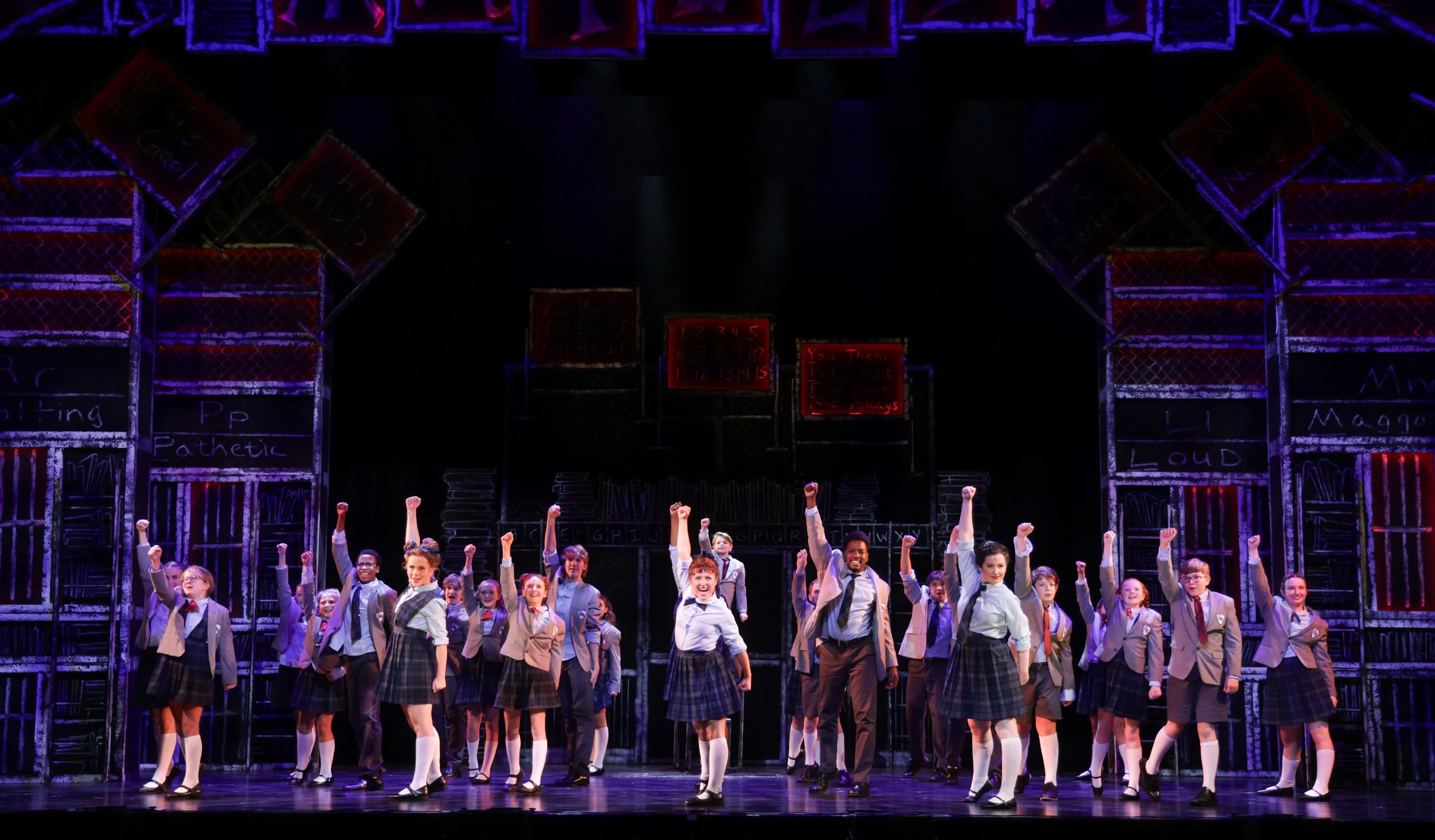
The Company of Matilda
Michelle Ney has designed a clever set, this one with blackboards that educate and imprison, menacing with Day-Glo chalk messages— a sinister school, indeed— in a production overseen by the invaluable Kevin D. Nedberg and The Lex’s beloved stage-manager Brandon T. Holmes. Supported by their dedicated crews! Marcus Ross, who has a theatrical resume to rival, uh, Bernadette Peters,has refined the sound, and Esther (“Of course I can fix it!”) Neel has wrangled a wide-world of props and special effects. And, as always at The Lex, Tanya Harper has spread color, stirred up shadows, guided the narrative and focus, and provided world-class stage lighting. These are amazing artists.
Yes, Matilda’s world might be a bit scary, but with mighty Matilda present, front and center and just “a little bit naughty,” all will be well.

The Lexington Theatre Company will present Matilda, the Musical for four evenings and two matinees, July 30-August 2 at the Lexington Opera House.

Kevin Lane Dearinger is the author of several plays, five books of poetry, theatre biographies and histories, and two memoirs (Bad Sex in Kentucky and On Stage with Bette Davis). His most recent publication is At the Lexington Opera House, a Scrapbook, 1887-2026, available at bookbaby.com, amazon.com, and better book shops. He will also probably sell you a copy from the trunk of his car.
